


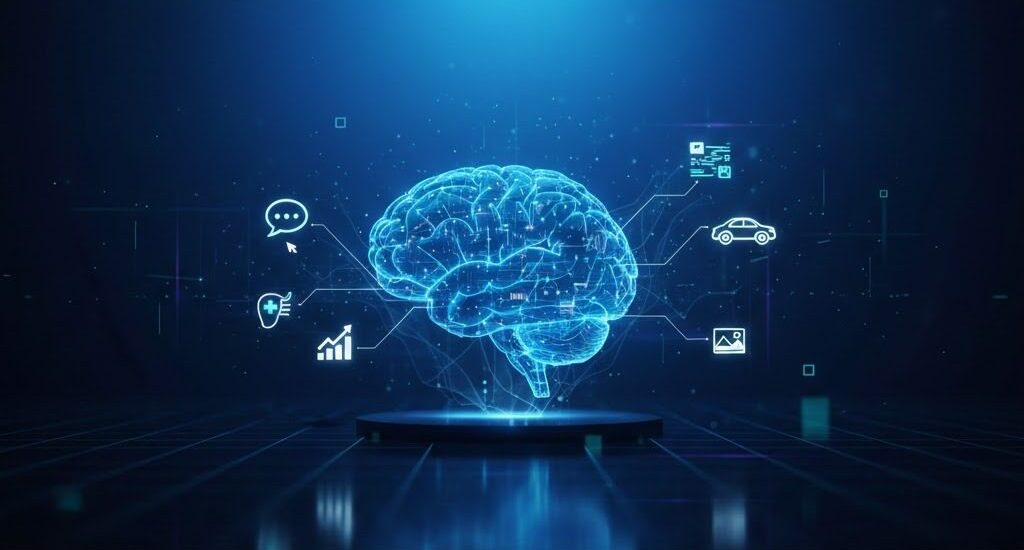
As we progress through 2025, artificial intelligence stands as a foundational pillar of technological advancement. Organizations and individuals increasingly depend on AI to tackle intricate challenges and streamline everyday processes.
The ongoing AI boom gains momentum from rapid progress in generative AI and large language models. Gaining a solid grasp of artificial intelligence is no longer optional—it’s critical for maintaining a competitive edge in today’s fast-paced world.
This comprehensive guide delves into what is artificial intelligence, its underlying mechanisms, and the transformative effects it delivers across various sectors.
What is AI and Why It Matters Today
Artificial intelligence encompasses AI systems capable of executing tasks that typically demand human-like cognition. These sophisticated systems analyze vast amounts of data to inform decisions and produce meaningful results.
In the current landscape, AI drives unparalleled efficiency and fosters innovation. Businesses harness AI to automate routine operations, deliver personalized customer experiences, and uncover actionable insights from complex datasets.
The emergence of accessible generative AI tools like ChatGPT has democratized AI use. From accelerating content creation to enhancing problem-solving, AI fundamentally reshapes professional and personal workflows.
Evolution into Enterprise AI Solutions (AI Work)
Early AI was limited to narrowly defined functions. Today, enterprise AI seamlessly embeds into large-scale business environments, enabling sophisticated operations.
Enterprise AI solutions empower companies to manage intricate workflows with precision. By leveraging machine learning models and cutting-edge AI technologies, these systems support predictive analytics and intelligent automation.
This progression directly tackles common business hurdles. Outdated manual methods hinder expansion, whereas enterprise AI offers scalable, dependable pathways to growth and operational excellence.
What is Artificial Intelligence?
Artificial intelligence empowers machines to replicate human cognitive abilities. The term was first introduced by John McCarthy in 1956, who described AI as the science of enabling a computer program to learn and perform tasks intelligently.
Contemporary modern AI depends on sophisticated AI algorithms combined with immense computing power to achieve remarkable outcomes.
Core Definition of Artificial Intelligence
Fundamentally, artificial intelligence represents the field of AI dedicated to developing capable AI systems that demonstrate reasoning, learning, and adaptation.
These AI systems designed for intelligence range from basic rule-based applications to advanced large language models. The overarching objective is building machines that handle responsibilities once exclusive to human intelligence.
AI vs. Human Intelligence: Key Differences
Human intelligence integrates creativity, emotional depth, and conscious awareness. In contrast, AI shines in rapidly processing large amounts of data with exceptional accuracy.
Current AI operates without genuine comprehension or awareness—it mimics intelligence by detecting patterns in training data. Though AI outperforms humans in targeted areas like complex computations, replicating broad general intelligence remains elusive.
History of AI
The history of AI reflects a journey filled with groundbreaking discoveries and periodic setbacks.
Key Milestones from Early Concepts to Modern Breakthroughs
The roots of early AI trace back to the 1950s, highlighted by Alan Turing’s Turing Test for assessing machine intelligence. John McCarthy‘s Dartmouth Conference formally launched AI as a discipline.
Notable achievements include AlphaGo defeating the world champion Go player in 2016. Progress in deep learning has since propelled the explosive rise of artificial intelligence.
AI Winters and the Recent Resurgence
The field endured “AI winters”—extended phases of diminished investment stemming from overhyped expectations. Major downturns hit in the 1970s and 1980s.
Renewed vitality emerged through enhanced computing power, access to vast amounts of data, and refined algorithms. Generative AI has ushered in a dynamic new chapter.
How Does AI Work?(AI agents and Agentic AI)
Grasping how AI works clarifies its practical power and limitations.
Core Components: Data, Algorithms, and Models
Successful AI hinges on three essential elements: data, algorithms, and models.
Training data forms the bedrock, teaching AI models to recognize patterns. Algorithms refine this information, while models generate predictions or actions.
Quality data used to train AI directly determines the reliability and effectiveness of outputs.
Role of Machine Learning in Powering AI Systems
Machine learning enables AI systems to evolve through experience. AI and machine learning are inextricably linked in most implementations.
Machine learning models detect intricate patterns autonomously, eliminating the need for exhaustive manual programming.
This capability allows AI to navigate diverse, unpredictable real-world situations effectively.
Deep Learning and Neural Networks Explained
Deep learning employs artificial neural networks modeled after the human brain’s structure.
Data flows through multiple layers, where features are automatically identified and refined.
This approach drives breakthroughs in computer vision, speech recognition, and natural language processing.
Types of AI
AI manifests in varied forms depending on scope and sophistication.
Weak AI vs. Strong AI
Weak or narrow AI specializes in specific task execution, such as virtual assistants handling queries.
Strong AI, synonymous with artificial general intelligence (AGI), would equal human intelligence across domains. It exists only in theory at present.
Current State: Narrow AI and the Path to Advanced Forms
All operational AI today is narrow-focused. Advances via AI agents signal movement toward more advanced AI.
Reaching AGI demands resolving substantial challenges in flexibility and reasoning.
Generative AI
Generative AI marks a paradigm shift in AI applications.
What is Generative AI and How It Creates Content
Generative AI crafts original outputs—text, images, code—using generative AI and large language models trained on enormous datasets.
These models anticipate sequences to produce coherent, contextually relevant results from user prompts.
Popular Tools Like ChatGPT and Their Impact
ChatGPT has mainstreamed generative AI applications, with millions relying on AI chatbots for drafting, coding, and creative ideation.
Such AI tools dramatically increase productivity, though they spark discussions on authenticity and creativity.
AI Agents and Agentic AI
Emerging developments focus on greater autonomy.
Understanding AI Agents
AI agents observe their surroundings and execute actions to meet objectives. AI agents and agentic AI manage complex, sequential operations.
They surpass basic reactive responses by pursuing broader goals intelligently.
Rise of Agentic AI for Autonomous Tasks
Agentic AI facilitates independent planning and execution. It underpins autonomous vehicles like self-driving cars and sophisticated automation.
Organizations increasingly implement agentic AI to achieve significant efficiency improvements.
Machine Learning Fundamentals
Machine learning serves as the core driver for most modern AI.
How Machines Learn from Data
Systems learn by iteratively tweaking parameters to reduce inaccuracies. AI learns from extensive amounts of data in structured training phases.
This refinement yields robust, capable AI systems ready for deployment.
Supervised, Unsupervised, and Reinforcement Learning
- Supervised learning relies on labeled examples to guide predictions.
- Unsupervised learning discovers hidden structures in unlabeled data.
- Reinforcement learning optimizes through trial-and-error rewards, excelling in dynamic environments like robotics.
AI Applications and AI Use Cases
AI use cases permeate consumer and professional realms.
Everyday AI Use in Consumer Tools
People routinely use AI in smartphones for recommendations, virtual assistants, and smart home controls.
AI chatbots deliver immediate, personalized assistance around the clock.
Enterprise AI Transforming Business Operations
Enterprise AI revolutionizes logistics, demand forecasting, and strategic planning.
It resolves bottlenecks that impede scaling, enabling sustainable business expansion.
AI Use Cases Across Industries
Applications of AI yield measurable advantages in diverse fields.
Healthcare, Finance, and Transportation
AI enhances diagnostic accuracy in healthcare and detects fraudulent activities in finance.
Self-driving cars and traffic optimization demonstrate AI improving safety and efficiency in transportation.
Retail, Manufacturing, and Cybersecurity Examples
Retail benefits from tailored recommendations. Manufacturing uses predictive maintenance to minimize downtime.
Cybersecurity employs AI for real-time threat identification and response.
ChatGPT and Similar Tools in Real-World Scenarios
Teams leverage ChatGPT-style tools for rapid report generation, idea development, and process optimization.
These generative AI tools integrate effortlessly into daily workflows.
Google AI and Leading Platforms
Prominent platforms advance AI research and accessibility.
Overview of Google AI Innovations
Google AI pioneers enhancements in natural language processing and computer vision.
These innovations power intuitive search, accurate translations, and intelligent cloud features.
Tools Like AI Studio for Developers
AI Studio simplifies crafting bespoke AI applications.
AI developers gain straightforward access to robust AI tools for prototyping and deployment.
Enterprise AI: Products and Services
Organizations require dependable, tailored implementations.
Business-Focused AI Solutions
Leading solutions integrate AI directly into core platforms, such as CRM systems enhanced with predictive insights or analytics engines for data-driven decisions.
These products and services accelerate meaningful adoption.
Key Products and Services Driving Enterprise Adoption
Scalable cloud-based offerings provide secure, flexible enterprise AI.
They mitigate common challenges around integration, compliance, and performance.
Our experienced team excels at deploying customized enterprise AI solutions aligned with your unique objectives.
We guide clients through every stage, from assessment to full implementation, overcoming obstacles with proven strategies.
Why choose us? We blend in-depth AI knowledge with hands-on expertise, delivering implementations that produce tangible ROI and seamless operational shifts.
Our client-centered approach prioritizes long-term success and adaptability.
Ethics, Risks, and Regulation of AI
Ethical considerations remain paramount for sustainable progress.
Bias, Privacy, and Alignment Challenges
AI may inherit biases from training data used in development. Data handling raises privacy concerns.
Ensuring alignment guarantees AI operates according to intended values.
Global Frameworks and AI Governance
International standards promote explainable AI, transparency, and accountability.
Robust AI governance supports responsible innovation while mitigating harms.
The Future of AI
The future of AI brims with promise and possibility.
Trends Toward Stronger AI Capabilities
Ongoing refinements in AI algorithms herald increasingly sophisticated AI systems.
Generative AI tools continue evolving, expanding creative and analytical frontiers.
Potential for Superintelligence and Societal Impact
Concepts of surpassing human intelligence provoke deep reflection on benefits and risks.
AI holds potential to address global issues, provided development proceeds thoughtfully.
Ensuring Responsible AI Development
In today’s rapidly evolving technological landscape, it is crucial to ensure that AI systems are developed with strong ethical guidelines and safety measures. AI can include a wide range of capabilities, from simple automation to complex decision-making processes that handle many tasks simultaneously. AI can help improve efficiency, solve complex problems, and enhance human productivity across industries. One popular form of ai is the ai chatbot, which uses natural language processing to interact with users conversationally. The technologies used in AI, such as machine learning and neural networks, rely on vast datasets and sophisticated algorithms. The use of ai has expanded dramatically, transforming how businesses and individuals operate. As ai becomes more advanced, innovations like gen ai (generative AI) enable creative content production and personalized experiences. Organizations often deploy multiple ai systems tailored to specific needs. At its core, ai enhances the ability of a computer to learn, reason, and adapt in ways that mimic human intelligence. While ai includes powerful tools that drive progress, it is essential to address potential risks, including the debated concern that unchecked advanced systems could pose an existential threat to humanity. By prioritizing transparency, fairness, and accountability, we can harness AI’s benefits responsibly.
Conclusion: Embracing Artificial Intelligence Responsibly
Artificial intelligence profoundly influences sectors and daily experiences. From foundational machine learning to innovative generative AI, its value is undeniable.
Forward-thinking organizations that strategically integrate AI secure lasting advantages.
Begin your journey today. Reach out to our specialists for expert, tailored advice on incorporating enterprise AI solutions.
We’re committed to supporting your responsible exploration of this transformative technology.
Frequently Asked Questions
How does AI work? AI functions by analyzing data via algorithms and models, frequently employing machine learning for continuous improvement.
What is artificial intelligence? Artificial intelligence simulates human intelligence in machines engineered to think, learn, and adapt.
Should AI be regulated? Experts widely advocate balanced regulation to manage risks like bias and privacy while encouraging beneficial innovation.
Will AI replace jobs? AI automates numerous tasks yet generates new roles, reshaping employment rather than eliminating it outright.
What can AI do today? Contemporary AI excels in content creation, analysis, personalization, and automation throughout industries.
Is AI a bubble? Despite excitement, core progress in AI technologies indicates enduring, substantive growth.
Which AI is best? Optimal AI varies by need—consumer tools like ChatGPT for text, or robust enterprise AI for operations.
Can AI replace teachers, doctors, or lawyers? AI augments these roles effectively but cannot substitute the human empathy and nuanced judgment essential to them.
Does AI consume excessive resources? Training advanced models requires substantial energy and water, driving industry focus on sustainable practices.
Will AI take over the world? Today’s narrow AI functions as a tool; broader existential concerns tied to future developments remain theoretical and actively debated.
Call to Action
Call/WhatsApp: +92 329 542 3419
Email: info@fracktechnologies.com
Visit: Office M 7, G-10/4, Islamabad